
Reviewed · CHICAGO SKYSCRAPER INTERIOR TOURS
Chicago Loop: Art, Skyscrapers, Millennium Park & “The Bean”
Chicago’s Loop is a compact lesson in how Chicago rebuilt itself after the Great Fire of 1871. In two hours, you move from the grand interiors of old department stores to Picasso’s steel sculpture, Tiffany glass, the raised train tracks, and the polished curves of Cloud Gate, better known as The Bean.
I like the way this tour connects architecture with city history, rather than treating the buildings as a parade of photo stops. I also like the weather plan: on cold or wet days, your guide spends more time inside handsome public buildings and lobbies. The main consideration is pace. At $49, you are paying for a focused introduction, not museum entry or a long architectural cruise.
Key points at a glance
- Starts at the Chicago Theatre: Meet your English-speaking guide at 175 N. State Street, at State and Lake.
- Covers classic Loop landmarks: See Macy’s on State Street, Daley Plaza, Millennium Park, Crown Fountain, the Art Institute, and Cloud Gate.
- Adds useful city context: Learn how the raised train system shaped the Loop and how Chicago recovered after the 1871 fire.
- Includes memorable public art: The route features Tiffany glass, Picasso’s sculpture, Crown Fountain, and The Bean.
- Adjusts to the season: Warmer days allow more time outdoors, while winter and rainy-day routes use indoor stops for warmth and history.
- Fits neatly into a morning or afternoon: The walking tour lasts two hours and includes live commentary from a local guide.
Why the Chicago Loop makes a smart first walk
If downtown Chicago feels like a wall of steel and glass when you first arrive, this tour gives you a readable map. The Loop is not just a business district. It is a concentrated mix of department-store history, public art, transportation, civic buildings, green space, and architectural change.
The route also gives you a useful timeline. You start with an older Chicago tied to retail and grand interiors, move through the modern art of Daley Plaza, then reach Millennium Park and Cloud Gate. Along the way, the Great Fire of 1871 explains why so many buildings represent a city rebuilding itself with confidence.
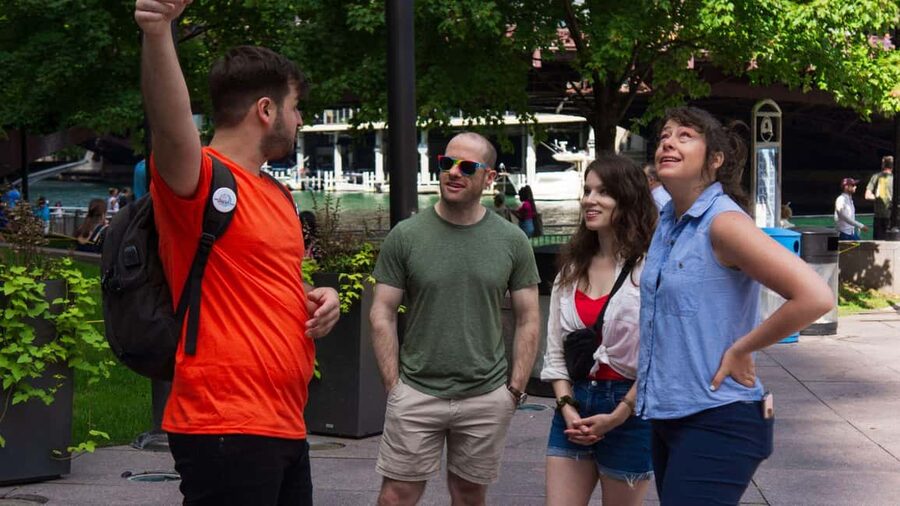
You meet at the Chicago Theatre, a practical downtown starting point at 175 N. State Street, on the corner of State and Lake. From there, the guide leads you through the central Loop on foot. The tour is offered in English, with live commentary from a Chicago local.
The six published ratings are all five-star ratings, and the strongest praise centers on the guide’s delivery. The route works best when the person leading it can explain architectural styles, add a joke at the right moment, and turn a familiar building into a story. That human touch is important here because many stops are public spaces rather than ticketed attractions.
More Millennium Park tours:
- Candle Making Experience Near Museums & Millennium Park
★ 5.0 · 7 reviews - Chicago Millennium Park Self-Guided Walking Tour
★ 4.5 · 5 reviews - Chicago: Downtown Loop & Millennium Park 2 Hour Walking Tour
★ 5.0 · 5 reviews
Macy’s on State Street and the memory of Marshall Field’s
The first major stop is Marshall Field’s, now Macy’s on State Street. The name has changed, but the building remains a reminder of the department store era, when shopping was also a form of public entertainment.
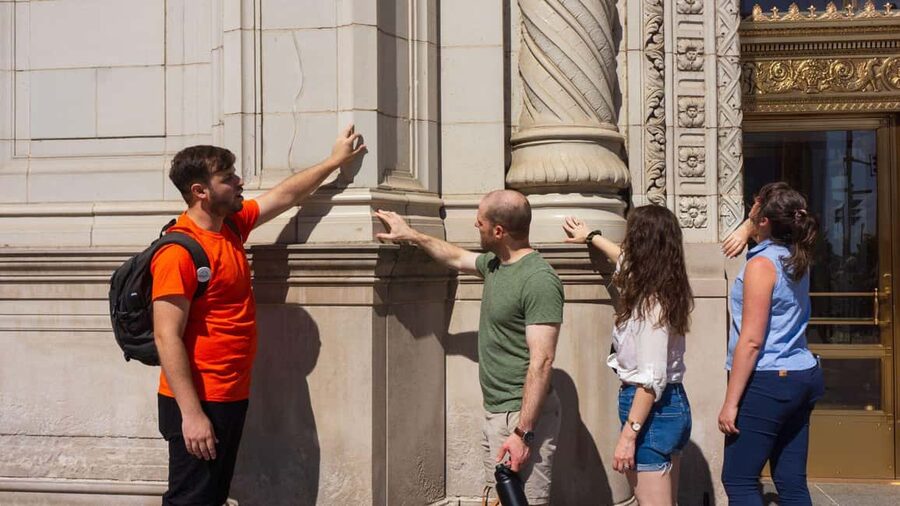
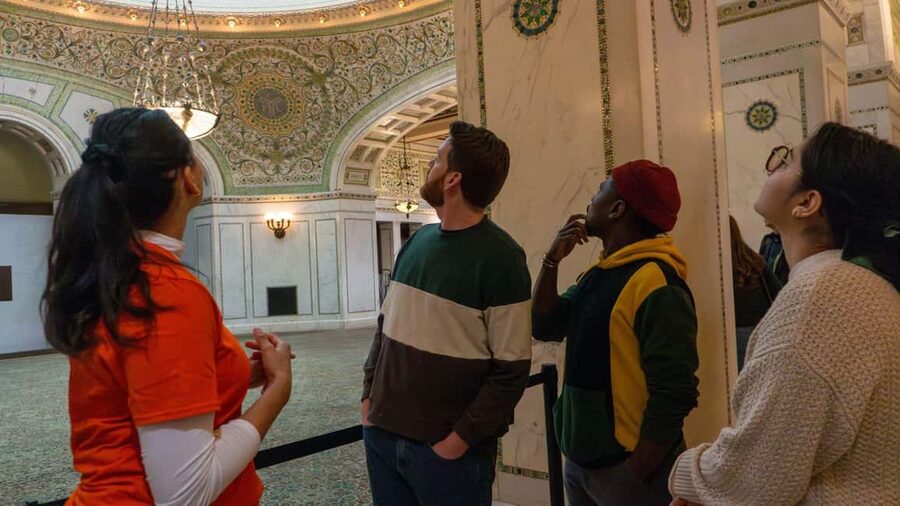
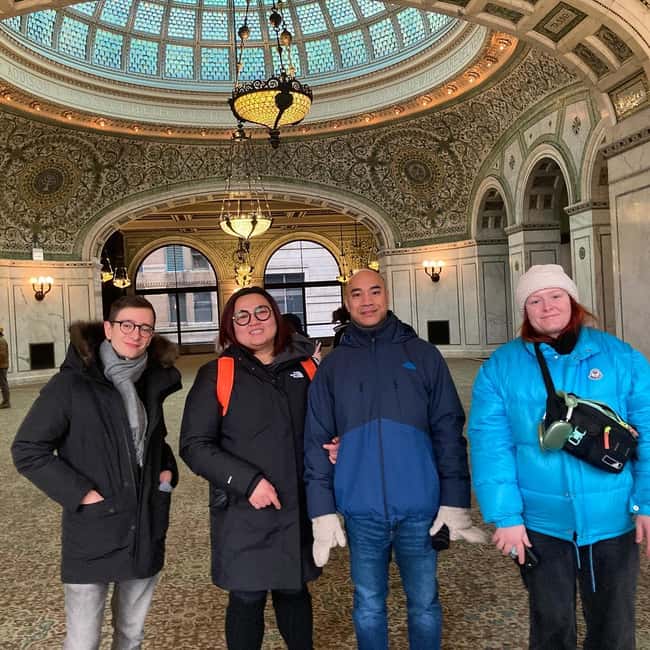
This is one of the route’s best indoor anchors. You can look up at the details, consider the scale of the building, and hear how the store fit into Chicago’s growth. The tour description places special emphasis on the architecture and public interiors, including delicate Tiffany glass.
That Tiffany work is a good reason to pay attention inside. It gives you a close look at the craftsmanship that can disappear when you rush through downtown. Instead of viewing Chicago only from the sidewalk, you get a sense of the care built into its commercial spaces.
You should not confuse this stop with a full department-store history tour. The visit is one part of a fast-moving two-hour walk, so the depth of the discussion will depend on the guide and the group. Still, it is a strong opening because it introduces Chicago through a building you can enter rather than simply photograph.
Daley Plaza and Picasso’s unexpected gift
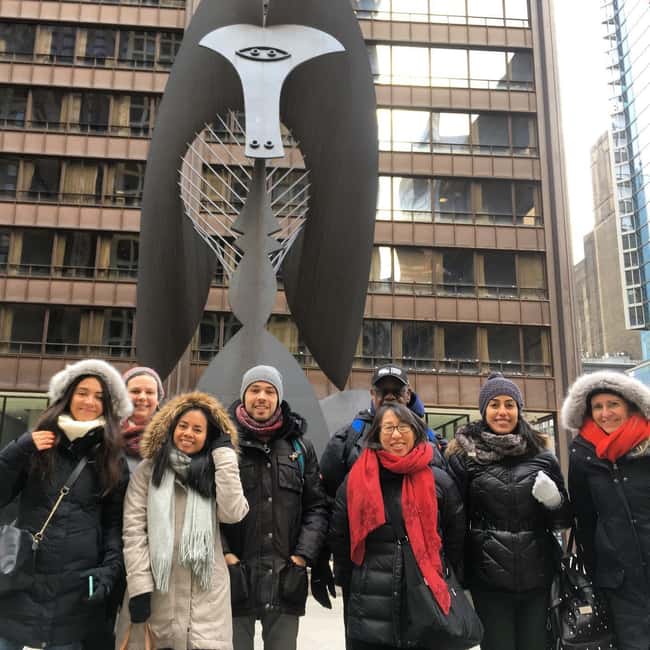
From State Street, the walk heads toward Daley Plaza and The Picasso. The sculpture is a large steel work given to Chicago by Pablo Picasso, and it remains one of the city’s most striking examples of modern public art.
The appeal is partly visual and partly historical. A traditional civic square might have received a heroic statue of a politician. Chicago instead accepted an abstract work that asks you to decide what you are looking at. That choice says something about the city’s interest in modern design and public art.
Your guide can also use the sculpture to explain how downtown plazas changed. The piece is not hidden inside a gallery. It occupies a public space where office workers, shoppers, and tour groups pass by. That makes it a useful contrast with the formal interiors at Macy’s.
The Picasso stop will suit you if you enjoy hearing why a work was placed where it is, not just learning its title. If you prefer long time for photography, keep an eye on the clock. The tour has several major stops still ahead.
The Great Fire and Chicago’s rebuilding story
The Great Fire of 1871 is one of the key historical threads running through the walk. You pass places built during Chicago’s rebuilding period, giving the fire a physical setting rather than leaving it as a date in a guidebook.
The value here is connection. You learn why Chicago became a testing ground for new building methods and ambitious design. The city’s skyline did not appear all at once. It grew from a period of loss, reconstruction, and new engineering ideas.
The tour does not present this as a formal museum lecture. Instead, the story appears as you move between buildings and public spaces. That keeps the history tied to what you can see around you, which is helpful if you are new to Chicago’s past.
The exact amount of detail will depend on your guide. The information provided does not name individual guides, so you should not book expecting a particular person. What you can expect is live commentary in English from a local guide, with the route built around stories, architecture, and public art.
More skyscraper interior tours in Chicago:
- Original Chicago Architecture Interiors Tour: Dazzling Interiors
★ 5.0 · 1,489 reviews - Chicago’s Secret Interiors Architectural Walking Tour
★ 5.0 · 635 reviews - Chicago: Secret Interiors Architecture Walking Tour
★ 4.9 · 498 reviews - Chicago Walking Tour: Art Deco Skyscrapers Loop
★ 5.0 · 138 reviews
Millennium Park and Crown Fountain
Millennium Park brings a change of pace. After the hard edges of the downtown streets, you reach a large public park that combines open space, art, and city life.
In warm weather, the tour spends more time here. That makes sense because the park is best understood as a place to move through rather than a single monument. Your guide can explain how the public art fits into the park while you take in the open setting.
Crown Fountain is one of the most playful stops. Video projections of Chicago residents’ faces appear on glass towers, with water cascading below. It combines local identity, technology, and a little mischief. You get a piece of public art that is easy to understand at first glance, yet still worth hearing about in context.
Winter changes the experience. The tour remains outdoors long enough to see the major sights, but it also shifts indoors for warmth and history. Charles, who took the tour in January, found this approach useful even on a beautiful day. That is a practical strength for anyone who wants a walking tour without committing to two hours in harsh cold.
The Loop’s raised trains and the meaning of the name
At some point, the route turns your attention upward to The L, Chicago’s raised train system. The train tracks are not just transportation infrastructure. They are part of the visual and everyday character of the Loop.
The name Loop comes from the elevated rail route that circles the central business district. Seeing the trains and tracks in place helps you understand how the downtown core works. You are not studying a diagram. You are standing beneath a system that has shaped the streets above and below it.
This stop is especially useful early in your Chicago visit because it gives you orientation. You learn how the central district is organized and why the raised lines are such a familiar part of the city’s image.
Do not expect a train ride as part of the tour. The activity is a walking tour, and the trains are viewed as part of the city’s infrastructure. If you want a dedicated public transportation experience, you would need to plan that separately.
Route 66, the Art Institute, and a famous starting point
The walk also reaches the downtown marker for Route 66, the legendary road stretching from Chicago toward California. The sign is a small stop with a large sense of place. It links the Loop to the idea of the American road trip and reminds you that Chicago has long been a starting point, not merely a destination.
Next comes the Art Institute of Chicago, one of the city’s major cultural landmarks. The tour includes the museum among its featured sights, along with paintings, sculpture, and cultural objects associated with the institution.
The important practical point is that this is a two-hour walking tour, not an Art Institute admission visit. You should not expect time to explore the museum’s collection in depth during this route. If the museum is high on your list, plan a separate visit and allow much longer.
Still, placing the Art Institute on the walking route is helpful. It connects the park and downtown architecture with Chicago’s wider cultural life. You get a sense of where the museum sits within the city rather than treating it as an isolated indoor stop.
Cloud Gate and the final photo stop
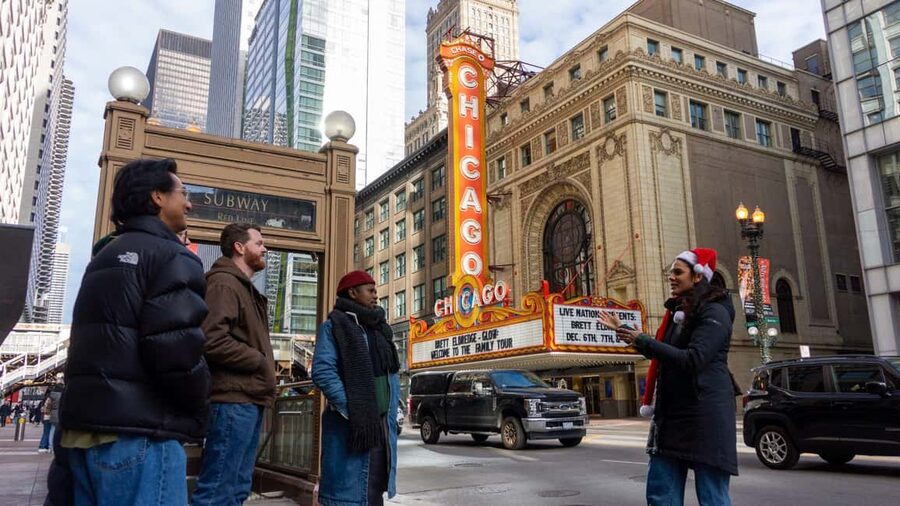
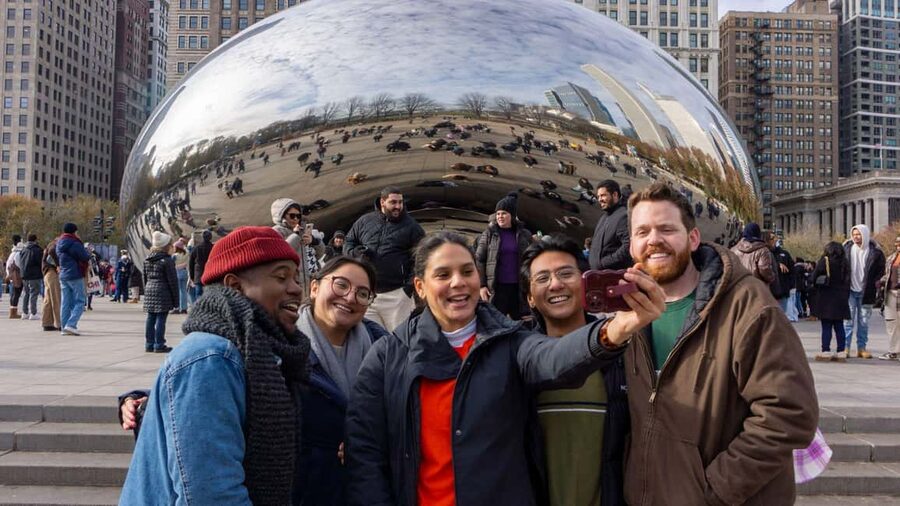
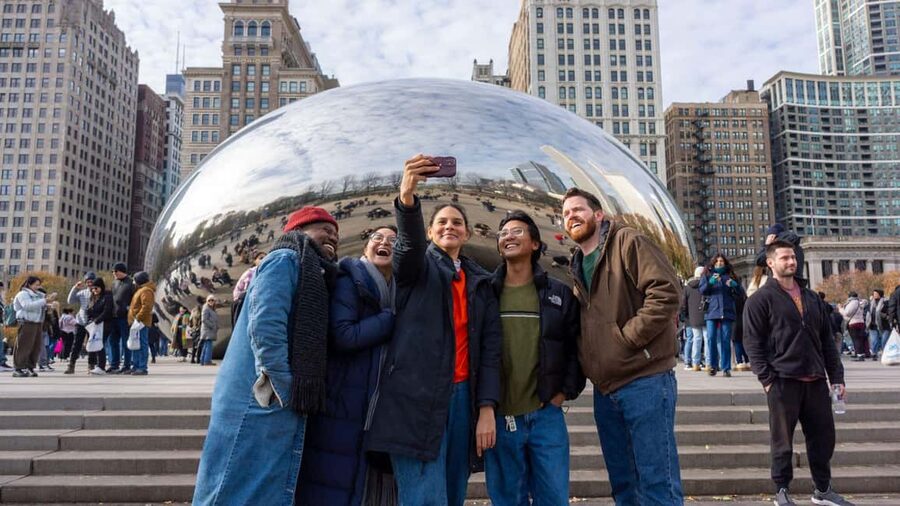
The route ends at Cloud Gate, the polished stainless-steel sculpture affectionately known as The Bean. Its curved surface reflects the buildings, sky, and people around it, making the sculpture work as both artwork and public meeting place.
You will probably want a photo here, and the tour gives you context before or around that moment. The Bean is easy to enjoy without an art degree. Its shape invites reflection, distortion, and group pictures, while its setting ties it to Millennium Park and Chicago’s modern identity.
The drawback is predictable: Cloud Gate is popular. You may find plenty of people around it, especially during a warm afternoon. The tour can explain the work and help you understand its place in the park, but it cannot control the crowd or guarantee an empty photo.
Ending here is satisfying because the route moves from older commercial interiors and civic spaces toward a very modern symbol of Chicago. You finish with a strong visual memory rather than a final block of background information.
How the two-hour format feels
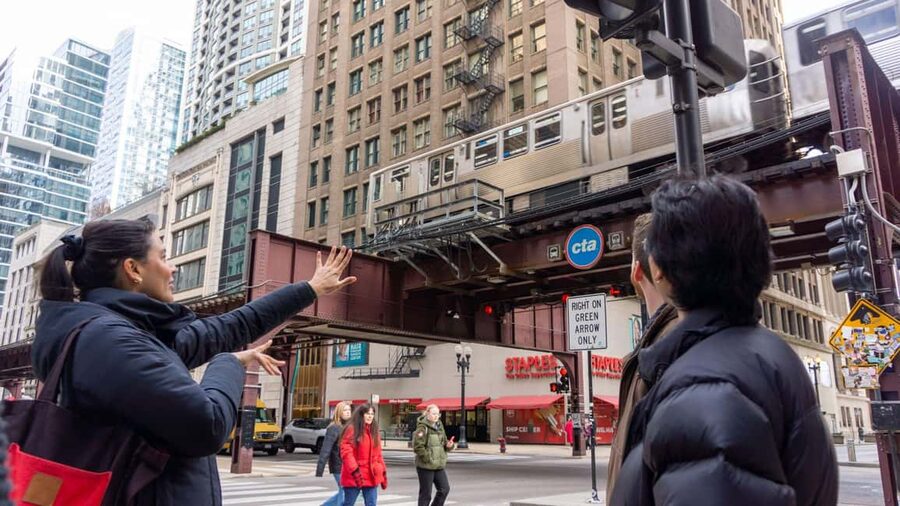
Two hours is enough to get a solid first look at the Loop without turning the day into an endurance test. The pace has been described as comfortable, and the route uses several short walks between major stops.
You should still wear comfortable shoes. This is a walking tour with outdoor sections, and the weather can affect how long you remain in Millennium Park or on the streets. Cold and rain do not cancel the city, but they can change your comfort level.
The schedule is usually available in the morning and afternoon. A morning departure may help you begin your sightseeing day with a clear sense of downtown. An afternoon option can work well after a museum or breakfast plan, though the exact amount of outdoor time will depend on weather and seasonal conditions.
The guide’s personality matters here. The most praised qualities are clear explanations, useful anecdotes, humor, and the ability to keep a small group involved. You are not simply following a flag through downtown. You are getting a local voice to explain why these places matter.
Is $49 a fair price?
At $49 per person, the value depends on what you want from a city tour. You are paying for a two-hour guided walk, local commentary, and a route that brings together several major Loop sights. You are not paying for museum admission, a train ticket, food, or gratuity.
I consider the price reasonable if you are visiting Chicago for the first time and want structure. In two hours, you receive orientation, architectural context, public-art background, and practical exposure to the central district. That can save you from wandering past important details without knowing what you are seeing.
The value is weaker if you already know the Loop well or prefer to explore at your own pace. You could walk through Millennium Park, photograph The Bean, and see the Route 66 sign without a guide. The tour earns its price through explanation, especially inside buildings and around works that benefit from context.
Gratuity is not included, so budget for that separately if you feel the guide provided a good experience. You can cancel up to 24 hours in advance for a full refund, and the reserve-now, pay-later option keeps your plans flexible.
Who should book this Loop walk?
I would recommend it to first-time Chicago visitors, architecture fans, public-art lovers, and anyone who wants a compact introduction before exploring more of the city alone. It also suits people who like history in small portions, with a guide who can connect the Great Fire, department stores, railways, and modern art.
It is a good cold-weather option because the route can include indoor buildings and lobbies. That does not turn it into a fully indoor activity, so dress for the forecast.
Families may enjoy Crown Fountain, The Bean, and The Picasso, though the tour’s main focus is architecture and history. Anyone seeking a long museum visit, a river view, or a high-rise lookout should choose a different activity or add those plans separately.
Should you book it?
Book this tour if you want the Loop explained rather than merely photographed. The strongest reasons are the mix of Tiffany glass, public buildings, Picasso, Millennium Park, the raised trains, Route 66, the Art Institute, and Cloud Gate, all tied together by a local guide.
Skip it if you want a slower museum experience or a boat-based view of Chicago’s architecture. At two hours, it is an introduction, not the whole city. For a first day downtown, though, $49 buys a useful orientation and a lively walk through the places that define Chicago’s center.
FAQ
How much does the Chicago Loop tour cost?
The tour costs $49 per person. Gratuity is not included.
How long does the tour last?
The walking tour lasts two hours.
Where does the tour meet?
Meet your guide in front of the Chicago Theatre at 175 N. State Street, at the corner of State and Lake.
What language is the tour offered in?
The tour is offered in English with a live local guide.
Which places are included on the route?
The route includes Macy’s on State Street, Daley Plaza and The Picasso, Millennium Park, Crown Fountain, the raised train system known as The L, the Route 66 starting-point sign, the Art Institute of Chicago, and Cloud Gate, also known as The Bean.
Does the tour operate in cold or rainy weather?
Yes. The route is adjusted to the weather, with more time in Millennium Park during warmer conditions and more indoor stops in winter or rain.
Is admission to the Art Institute included?
The activity information lists the Art Institute as a stop, but it does not include museum admission among the inclusions. The tour is a two-hour walking experience.
Can I cancel the booking?
You can cancel up to 24 hours in advance for a full refund. A reserve-now, pay-later option is also available.
Recently added around Chicago
- Travel between Chicago O’Hare and Madison★ 4.5 · 4 reviews
- Volo Auto Museum: Admission Ticket★ 4.5 · 55 reviews
- Holiday Walking Tour: Underground Chicago via the Pedway★ 5.0 · 27 reviews
- Workers Cottages of Oldtown Triangle Walking Tour★ 5.0 · 45 reviews
- Verse Immersive Holographic Theater in Chicago★ 4.5 · 28 reviews
- Vito’s Vault Chicago finest dinner theatre speakeasy★ 5.0 · 14 reviews
- Delicious Donuts & Sweet Treats: West Loop Walking Tour★ 5.0 · 47 reviews
- Traveling Spoon Chicago-Style Deep Dish Pizza Private Online Cooking Class★ 5.0 · 4 reviews
Chicago Skyscraper Interior Tours, compared.
Original Chicago Architecture Interiors Tour: Dazzling Interiors
Read our review →
Chicago’s Secret Interiors Architectural Walking Tour
Read our review →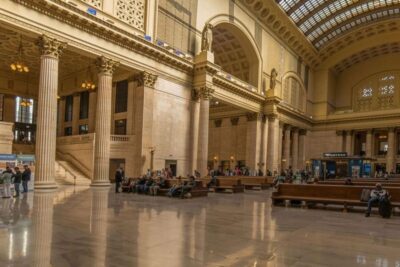

Chicago Walking Tour: Art Deco Skyscrapers Loop
Read our review →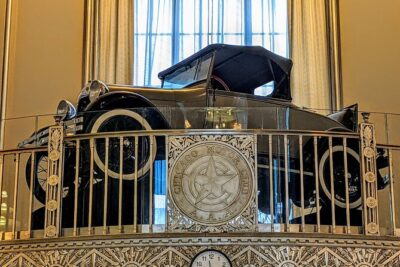
Chicago Architecture Walking Tour: Incredible Art Deco Interiors
Read our review →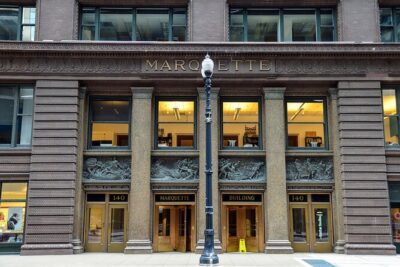
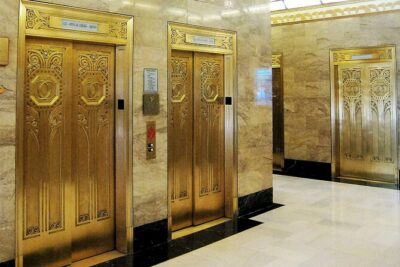
Chicago Walking Tour: Art Deco Skyscrapers Riverfront
Read our review →
Chicago’s Original Dazzling Architectural Interiors Tour
Read our review →Browse the lists this tour appears in