
Reviewed · CHICAGO WALKING TOURS
Chicago’s Midway, Movies, and the 1893 World’s Fair Walking Tour
Chicago’s Midway Plaisance is more than a strip of parkland between the University of Chicago and Washington Park. On this small-group walk, it becomes a movie set, an outdoor museum, and the former amusement zone of the 1893 World’s Columbian Exposition. You’ll connect Lorado Taft’s sculpture studio with the birth of commercial film and see how Chicago helped shape screen culture.
I like the tour’s tiny maximum of four people, which gives Kelli room to answer questions and adjust the pace. I also like the use of film clips, photos, and old moving-picture devices, since the story is not left to dates and names alone. The main consideration is weather: this is an outdoor walk, and the non-refundable booking policy makes a forecast check wise.
Key points to know before you book
- Small group of four: You get a more personal walk and a better chance to ask Kelli questions.
- A rare film-history angle: The tour links the 1893 World’s Fair to the first commercial movie theater.
- Three focused stops: Lorado Taft’s studio, Midway Plaisance, and the Fountain of Time each add a different piece of the story.
- Historic media in hand: Film clips, photos, and a demonstration of 19th-century moving-picture devices make the past easier to picture.
- A 90-minute morning walk: The 10:30 a.m. start leaves much of your Chicago day open.
- Outdoor and weather-dependent: There is no private transportation, so dress for the conditions and expect to walk between sites.
Why Chicago’s Midway makes a fine movie-history tour
Many Chicago tours lean on skyscrapers, gangsters, architecture, or deep-dish pizza. This one takes a quieter route. The Midway Plaisance does not have the instant visual punch of downtown, but its connection to the 1893 fair gives the area unusual importance.
The fair helped present new technology and new forms of entertainment to a huge public. The Midway was the fair’s amusement arm, and this tour uses that setting to explain how moving pictures began to shift from a technical novelty into a public attraction.
That focus gives the experience a useful balance. You are not simply looking at old buildings or hearing a string of film trivia. You are learning how artists, machines, public amusements, and Chicago’s fair culture crossed paths.
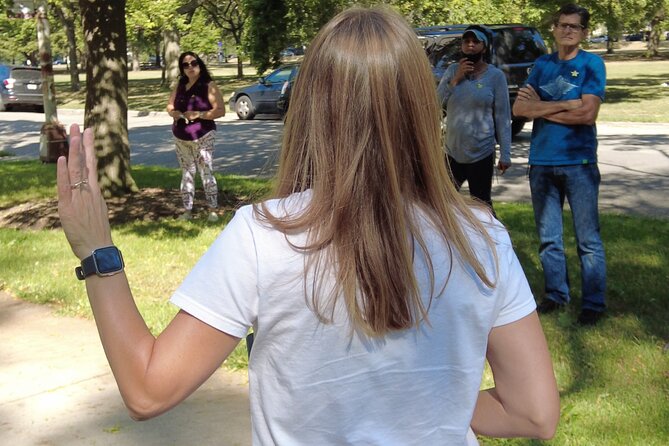
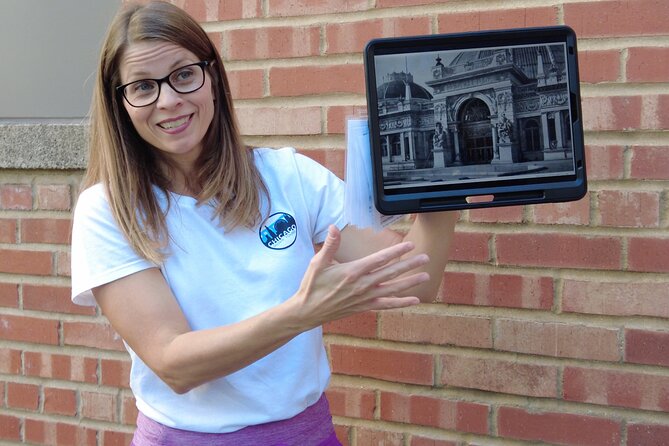
Kelli leads the walk, and her approach includes visual material rather than relying only on spoken explanation. That matters here. Early film is easier to understand when you can see a clip or a photograph at the moment the story reaches it. The included demonstration of a 19th-century moving-picture device adds a hands-on element to what could otherwise feel like a very specialized subject.
The group limit is one of the strongest practical features. With no more than four people, you can usually expect a conversation rather than a speech delivered to a crowd. If you want a guide who can pause over a question or explain a detail in a different way, this format has a clear advantage.
More Midway airport transfers:
- Private Arrival Transfer from Chicago Airports (ORD) (MDW)
★ 3.5 · 196 reviews - Private Departure Transfer to Chicago Airports (ORD)(MDW)
★ 4.0 · 91 reviews - Private Transfer Chicago Airport MDW to Chicago Downtown
★ 3.5 · 54 reviews
Lorado Taft’s Midway Studios begins the story
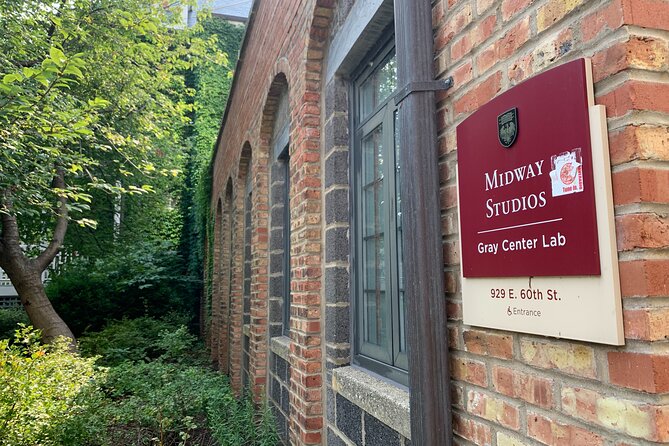
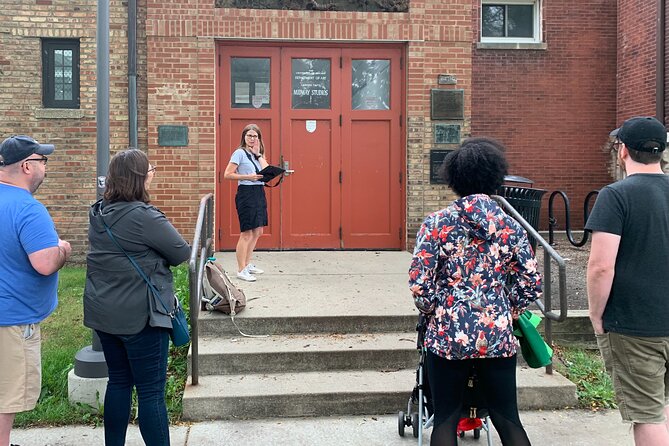
The tour starts at Midway Studios and Taft House, 6016 South Ingleside Avenue. The opening stop lasts about 30 minutes, making it the most substantial part of the walk.
Here you get acquainted with Lorado Taft as more than a sculptor. He was also a teacher, writer, and early adopter of moving pictures. That combination gives the tour its central thread: art and new technology were not separate worlds. An artist working in Chicago could be interested in both monumental sculpture and the latest ways to record motion.
The setting helps make that point. Rather than beginning with an abstract lecture about early cinema, the tour places the subject inside Taft’s working world. You can consider how artists viewed new visual tools and why moving images caught their attention.
The stop also includes the Recording Angel, a sculpture connected with Taft, along with film material showing Hollywood’s first female action star in motion. The pairing is unusual. You see a fixed work of art while also considering the energy and movement that film can capture.
Kelli’s use of clips and photographs should be especially helpful here. Early cinema can be hard to imagine from words alone, and the visual examples give you something concrete to study. The 19th-century moving-picture demonstration adds another layer by showing the mechanical side of the medium.
Allow enough time to arrive before the 10:30 a.m. meeting time. Since the tour begins at a specific house and studio address, you will want to confirm your route in advance rather than assume the meeting point is at a large, obvious public entrance. The tour does not include private transportation, so you are responsible for getting to the start and from the end.
The Midway Plaisance connects fairground fun with film
From Midway Studios, the walk continues to the Midway Plaisance. This section lasts about 15 minutes, but it carries much of the tour’s historical argument.
The Midway was the amusement area of the 1893 World’s Columbian Exposition. Its role was not simply to provide a pleasant place to stroll. It was where fairgoers could seek entertainment, spectacle, and new experiences after seeing the exhibition buildings and displays.
The tour explains how that culture of amusement included the first commercial movie theater. That detail helps you picture the early film audience as part of a larger public eager to see machines and performances that felt new.
You may already know that moving pictures developed through inventions and experiments. This walk adds the social side. A device becomes important when people pay to see it, gather around it, and treat it as entertainment. The Midway provides the setting for understanding that shift.
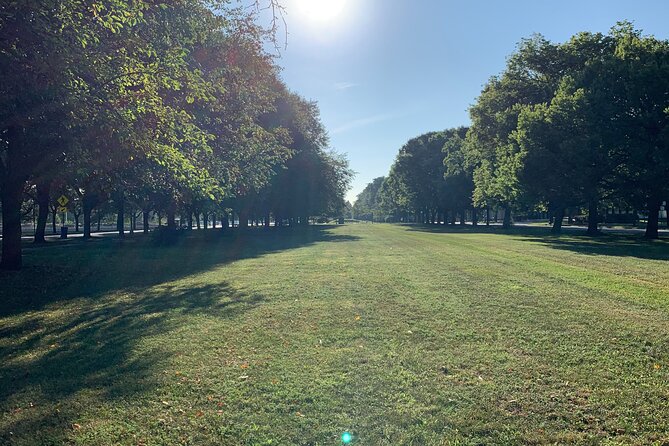
The open green space also changes the rhythm of the tour. After the indoor and sculpture-centered opening stop, you are out in the area where fair amusements once drew attention. It is a good place to think about scale and crowds, even though the present-day setting is not the 1893 fair itself.
Do not expect reconstructed fair buildings or a large museum exhibit. The value is in the explanation and the connection between place and event. The Midway is now a public green space, so the experience depends on Kelli’s storytelling, visual aids, and your ability to imagine the earlier activity.
That is also why the tour works best for people who enjoy context. If you want a series of major attractions that you can enter and photograph on their own, this may feel understated. If you like learning why an ordinary-looking place matters, the stop offers more than its short time suggests.
The Fountain of Time gives the walk a dramatic finish
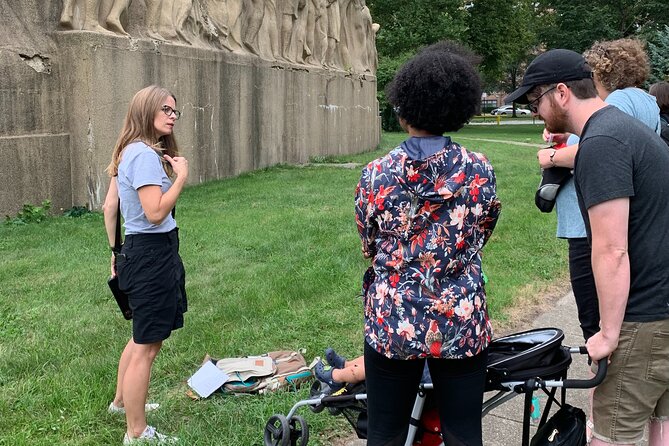
The final stop is the Fountain of Time in George Washington Park, at 6000 South Cottage Grove Avenue. The visit lasts about 15 minutes and ends the tour with one of the area’s most striking works of public art.
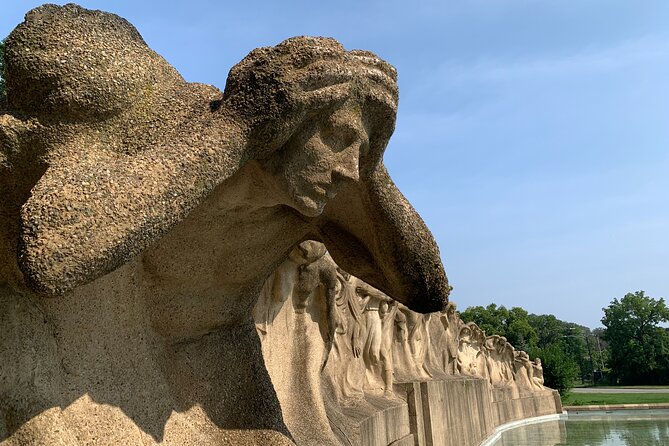
The sculpture is 126 feet long, so its size gives the ending a strong visual punch. It also has a direct film connection, having inspired both classic and modern filmmakers. That makes it a fitting final stop for a tour about time, motion, images, and the way artists turn ideas into visual scenes.
After hearing about a sculptor’s interest in moving pictures and the fair’s early movie theater, you arrive at a work that itself has influenced filmmakers. The sequence creates a clear arc without needing a long itinerary.
The Fountain of Time is also a good place to take photographs. The tour includes plenty of Instagram opportunities, but the photos are most useful when they support the story rather than interrupt it. You can record the sculpture, its scale, and the setting while still keeping the film-history theme in view.
The tour ends here, not back at Midway Studios. Plan your onward route with that in mind. The end point is at George Washington Park, and you will not have private transportation included to return you to the starting point.
More walking tours in Chicago:
- Chicago: Gangsters and Ghosts Walking Tour
★ 5.0 · 7,155 reviews - Chicago Favorites Ultimate Food and Walking Tour
★ 5.0 · 1,962 reviews - Chicago: Gangsters and Ghosts Guided Walking Tour
★ 4.7 · 1,697 reviews - Chicago in a Day: Food, History & Architecture Walking Tour
★ 5.0 · 1,153 reviews
What the included visuals add to the experience
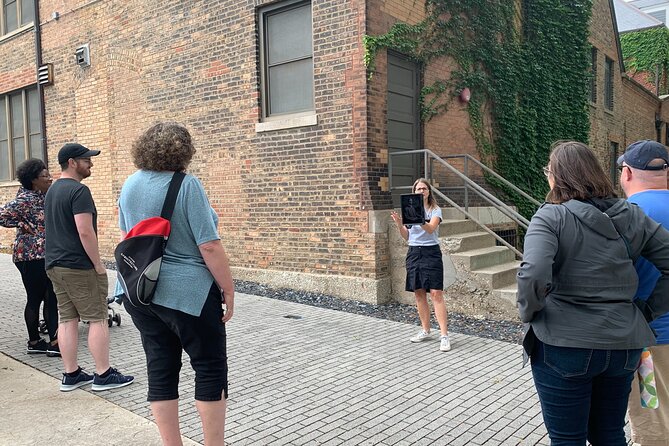
The strongest part of this tour is not simply the number of stops. It is the way Kelli uses media to make a specialized subject easier to follow.
You can expect:
- Film clips tied to the places and people discussed
- Photos that help show the area’s earlier role
- A demonstration of 19th-century moving-picture devices
- Commentary about Chicago, the fair, sculpture, and cinema
- A small goodie bag
- Time for photographs
The clips are important because early film history can quickly become a list of inventions and dates. Seeing motion, rather than only hearing about it, helps explain why these devices attracted public attention.
The demonstration is useful for a different reason. It points to the physical process behind moving pictures. Before film became a familiar form of entertainment, viewers encountered mechanical systems that created the impression of motion. Watching a demonstration can make that transition less mysterious.
The visual material also gives the tour a practical advantage in poor visibility or cold conditions. One person who took a February walk found that Kelli used underground walkways effectively to keep the group warm and dry. The supplied details do not promise a specific route in every condition, but they do suggest that Kelli pays attention to comfort and navigation when weather is unpleasant.
Is $49.99 a fair price?
At $49.99 per person, this is not a cheap way to fill 90 minutes. You are paying for a specialized subject, a private-feeling group size, a guide, visual material, and a demonstration rather than admission to a major museum or monument.
The value improves if you care about Chicago’s connection to film, public art, or the 1893 fair. A standard sightseeing walk may mention the World’s Fair in passing. This tour makes it the main subject and adds a film angle that is harder to find in a general city tour.
The maximum of four is also significant. Many walking tours depend on larger groups to keep the price low. Here, the small size gives Kelli more room to communicate directly and respond to the group. If a personal guide relationship matters to you, that is a real part of the price.
The experience is less compelling if you want a long route packed with famous attractions. The walk lasts about an hour and a half, with roughly 30 minutes at the studio and about 15 minutes at each of the other two stops. The remaining time is used for walking, explanation, and transitions. You are buying focus and access to a particular story, not a full tour of Chicago.
Who will enjoy this walk most?
I would recommend this tour to film fans, Chicago repeat visitors, history-minded families, and anyone who enjoys seeing a familiar city through a narrow but revealing subject.
It also suits people who have already spent time downtown and want to explore another part of the city. One useful feature of this route is that it can show you places you might otherwise pass without understanding their importance.
Families may appreciate the clips, moving-picture demonstration, and short duration. The small group makes it easier for younger participants to ask questions, though the tour still depends on attention to historical explanation.
Architecture and public-art fans have good reason to consider it too. Taft’s studio and the Fountain of Time give the walk a strong visual side, while the Midway supplies the broader fair setting.
You should think twice if you dislike outdoor walks, need a fully indoor activity, or want a flexible cancellation policy. The experience requires good weather, and the booking is non-refundable unless the operator cancels because of weather or an unmet minimum group size.
The tour is offered in English. Service animals are allowed, the route is near public transportation, and most people can participate. If you have specific mobility needs, you should confirm the route details before booking, since the experience involves walking between three locations and does not include private transport.
Timing, meeting point, and group size
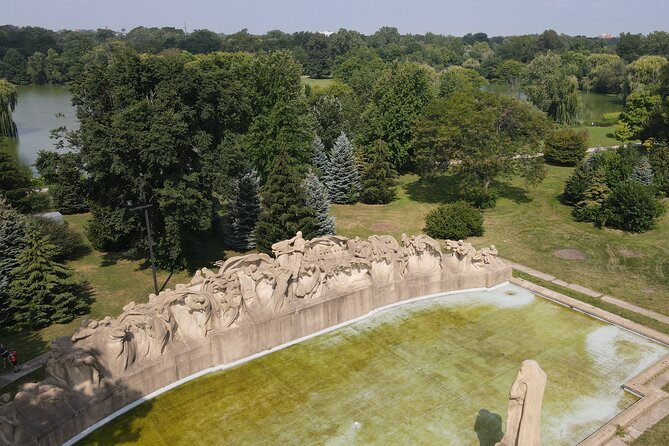
The meeting time is 10:30 a.m. at Midway Studio, 6016 South Ingleside Avenue. The tour ends at the Fountain of Time in George Washington Park, 6000 South Cottage Grove Avenue.
The one-way arrangement is worth planning around. You do not return to the starting point, so think about your next stop before you set out. Since the walk is near public transportation, you have options for continuing your day, but the exact trip will depend on your plans.
A 10:30 a.m. start is convenient for a morning activity. You can finish around noon and still have most of the afternoon available. It also gives you a clear reason to avoid a rushed morning, since being late may mean catching up with the group rather than starting comfortably.
The group can include no more than four people. That is unusually intimate for a scheduled walking tour and may be especially useful if your group wants to ask about film details, Chicago history, or the sculptures along the route.
Should you book Chicago’s Midway, Movies, and the 1893 World’s Fair tour?
Book it if you want a focused Chicago experience that connects art, technology, public entertainment, and film. Kelli’s visual teaching style, the small group, and the rare subject make this more distinctive than a standard neighborhood walk.
The best reason to choose it is the way the three stops build on one another. Taft introduces the artist and early moving-image interest. The Midway explains the fair’s entertainment culture and first commercial movie theater. The Fountain of Time closes the story with a large public sculpture tied to filmmakers.
Skip it if you want major indoor attractions, a long city route, or a flexible cancellation policy. For everyone else, especially film fans and Chicago visitors ready to look beyond the usual downtown circuit, $49.99 buys a compact, thoughtful morning with a story you are unlikely to get from a general sightseeing tour.
FAQ
How long is the Chicago’s Midway, Movies, and the 1893 World’s Fair Walking Tour?
The tour lasts approximately 1 hour and 30 minutes.
Where does the tour begin?
It begins at Midway Studio, 6016 S Ingleside Avenue, Chicago, Illinois 60637.
Where does the tour end?
The tour ends at the Fountain of Time in George Washington Park, 6000 S Cottage Grove Avenue, Chicago, Illinois 60637.
What time does the tour start?
The scheduled start time is 10:30 a.m.
How many people can join the tour?
The experience has a maximum of four travelers.
What happens if bad weather cancels the tour?
If poor weather causes a cancellation, you will be offered a different date or a full refund. The experience is otherwise non-refundable and cannot be changed for any reason.
Recently added around Chicago
- Travel between Chicago O’Hare and Madison★ 4.5 · 4 reviews
- Volo Auto Museum: Admission Ticket★ 4.5 · 55 reviews
- Holiday Walking Tour: Underground Chicago via the Pedway★ 5.0 · 27 reviews
- Workers Cottages of Oldtown Triangle Walking Tour★ 5.0 · 45 reviews
- Vito’s Vault Chicago finest dinner theatre speakeasy★ 5.0 · 14 reviews
- Verse Immersive Holographic Theater in Chicago★ 4.5 · 28 reviews
- Delicious Donuts & Sweet Treats: West Loop Walking Tour★ 5.0 · 47 reviews
- Traveling Spoon Chicago-Style Deep Dish Pizza Private Online Cooking Class★ 5.0 · 4 reviews
Chicago Walking Tours, compared.
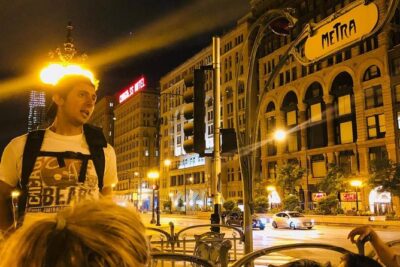

Chicago Favorites Ultimate Food and Walking Tour
Read our review →
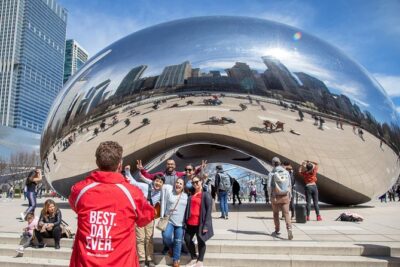
Chicago in a Day: Food, History & Architecture Walking Tour
Read our review →
Chicago’s Secret Interiors Architectural Walking Tour
Read our review →

Browse the lists this tour appears in